
There is a tenderness in an almost empty perfume bottle. The label has faded. The stopper resists. At the bottom, a little amber liquid catches the light.
You no longer wear it, yet throwing it away feels impossible. What, exactly, would you be discarding? Glass? Fragrance? Or the last physical connection to someone you used to be?

The Quiet Intimacy of Personal Effects
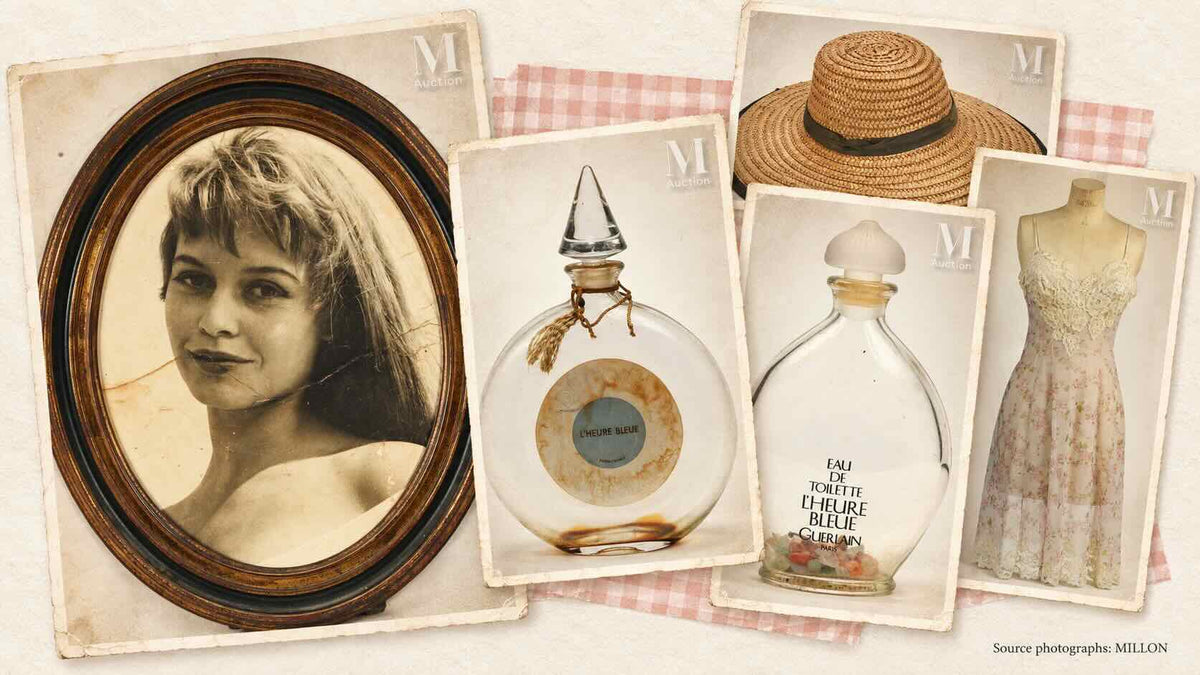
Looking at Brigitte Bardot’s personal effects brings that question into focus. Beyond the familiar photographs and cinematic mythology are intimate, ordinary things: a straw hat, a floral slip, a small gold mesh purse, a bracelet bearing her name. Objects close enough to touch skin.
MILLON’s September 2026 auction brings together belongings from her homes in Saint-Tropez and Paris. In the accompanying images, these possessions feel less like trophies than fragments of daily life. Their wear invites attention.

A pristine object tells us what someone bought. A worn object makes us wonder how they lived.
Brigitte Bardot’s Perfume Bottles
Among the most arresting images are two bottles labelled L’Heure Bleue by Guerlain. One holds small coloured pieces at its base; another shows amber residue beneath an aged label and tasselled cord. Nearby is a Rochas Eau de roche jar labelled as foaming bath crystals. Even the distinction matters: fragrance belonged to bathing, dressing, and private hours, as well as appearances.
We cannot know from a photograph when Bardot reached for these objects, or what each meant to her. They leave room for questions that a polished publicity portrait rarely permits. What did she keep within reach? What became familiar enough to disappear into the background of a day?
L’Heure Bleue offers an evocative starting point. Created by Jacques Guerlain in 1912, its name means “the blue hour.” Guerlain describes a composition spanning anise and bergamot, floral notes including neroli and carnation, and a powdery base with iris, vanilla, benzoin and tonka bean.
It is easy to understand why such a perfume invites thoughts of thresholds: afternoon becoming evening, anticipation becoming memory.
Yet a list of notes can only explain so much. The same perfume might mean a mother’s dressing table to one person and a first apartment to another. Its emotional character comes partly from the life lived around it. We give fragrance its associations through repetition, almost without noticing.
Do we miss the fragrance itself, or the way the world felt when we wore it?
The Fragrance of Who We Were
Think of the perfume you wore before you felt comfortable in your own skin. Perhaps you chose it because its advertising promised confidence. Perhaps someone you admired wore it. Each morning, you borrowed a little of that imagined identity.
Years later, the scent may return you to the person who was trying, rather than the person you eventually became.
That can be moving. We often remember our younger selves through decisions we now question, clothes we would never wear, people we should have left sooner. An old fragrance can make those judgments soften. For a moment, we remember the hope inside the uncertainty. We recognise how earnestly we were living.
Why We Keep Old Perfume Bottles
A summer seemed endless. An unfamiliar city promised reinvention. Someone was waiting downstairs. The bottle gathers these details without arranging them into a story. We supply the story each time we lift the cap, discovering that what we long for can change as we do.
Sometimes it belongs to someone else. A grandmother’s perfume, a partner’s cologne, the familiar scent of a friend whose life has drifted away from ours. Keeping it can feel like maintaining a small doorway. We may leave it untouched for years, reassured simply by knowing it is there.
The bottle cannot preserve everything. Fragrance changes with time; so does our recollection. The person we remember may already be partly an invention, assembled from affection, distance and the details we have repeated. Still, the encounter can feel true. Memory does not need to be complete to matter.

The bottle cannot preserve everything. Fragrance changes with time; so does our recollection. The person we remember may already be partly an invention, assembled from affection, distance and the details we have repeated. Still, the encounter can feel true. Memory does not need to be complete to matter.
Celebrity memorabilia magnifies this instinct. We look at Bardot’s belongings and imagine proximity to a life we know mostly through images. But the more interesting question turns back towards us: which of our own possessions would explain something a photograph could not? Which small, unremarkable thing has absorbed an entire chapter?
"They may call me a sinner, but I am at peace with myself"
Brigitte Bardot

Recreate the Mood with ēma Fragrance
At ēma, this is where fragrance becomes an invitation to create. To revisit the romantic atmosphere suggested by these bottles, we would begin with Bergamot, French Jasmine and Vanilla. Think of this as a personal interpretation of vintage softness and warmth. Three notes cannot reproduce L’Heure Bleue’s intricate composition, and this pairing makes no claim to be Bardot’s own blend.


A Personal Scent Ritual
Vanilla: Start with a light application for warmth.
French Jasmine: Add a soft layer for a luminous floral heart.
Bergamot: Finish with a smaller touch for brightness.
Let the combination settle on your skin before deciding what it needs. More jasmine might suggest an evening garden; more vanilla might feel closer to a remembered embrace. Let your own associations lead the way.
The intimacy of solid perfume suits this exercise. You open a compact, warm the fragrance with a fingertip, and apply it deliberately. A refillable compact can remain beside you while the fragrances inside change, becoming another familiar object carried through different seasons of life.

What Will You Remember?
Perhaps the pleasure in nostalgic memorabilia is the permission it gives us to care about small things. A worn ribbon. An engraved bracelet. An empty bottle with a beautiful stopper. Their value resists explanation because it belongs to a relationship between object and person, between then and now.
You do not have to wear your old perfume again. You do not have to become that earlier self. You can keep the bottle, acknowledge what it holds, and choose something new for today.
One day, that fragrance may stop you in your tracks. What will it bring back? Who will you remember being?


A Parting Note
Maybe that is the quiet truth of perfume bottles: they are never only decorative. They are witnesses. They remember the hand that reached for them, the room they sat in, the version of a life that once felt entirely present. To keep one is not to live in the past. It is to admit that the past still speaks in small, scented ways. We can let it speak, then turn gently toward what we want to become next.

Share:
Sézane Solid Perfume and the Rise of French Girl Fragrance